
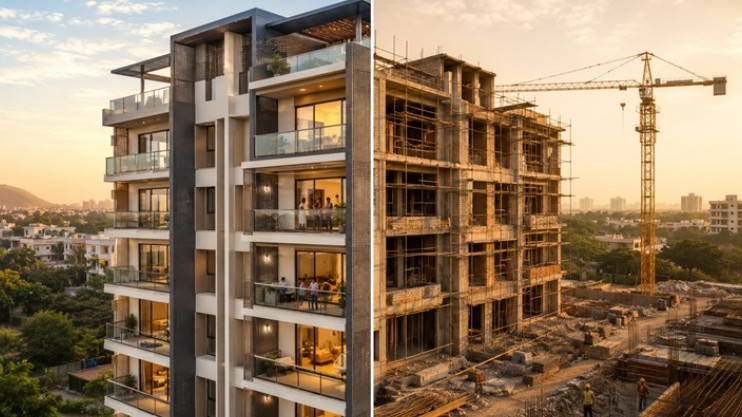
Ready possession flats in Pune cost more upfront but skip GST, hand you the keys immediately, and remove construction risk entirely. Under-construction or new-launch flats cost less at booking, spread your payments over the build period, and tend to offer better appreciation in growth corridors like Mahalunge and Sus, but you’re trading a lower price for a wait and some uncertainty. The right choice depends less on which option is “better” and more on your timeline, your budget structure, and how much risk you’re comfortable carrying. This guide walks through the real trade-offs using live projects in west Pune, so you can match the decision to your situation.
Picture this. You’ve shortlisted two flats. One is move-in ready next month. The other is still rising, floor by floor, with possession promised in late 2028. The ready flat costs ₹15-20 lakh more. The under-construction one asks you to wait nearly two years and trust a possession date on paper.
This is the moment almost every Pune homebuyer hits, and it’s rarely about which option is objectively superior. A ready-to-move flat and a new-launch, under-construction project solve different problems. One gives you certainty today. The other gives you a lower entry price and more time to pay, in exchange for patience.
This guide breaks down ready possession vs under-construction flats in Pune using real cost factors (including GST, since that one catches most first-time buyers off guard), real timelines, and real projects currently available in Baner, Mahalunge, Balewadi, Sus, and Pashan. By the end, you’ll know exactly which type of property matches your situation, not just which one sounds better in a brochure.
What’s the Real Difference Between Ready Possession and Under-Construction Flats?
A ready possession flat is one where construction is complete and the developer holds an Occupancy Certificate (OC), meaning you can move in or rent it out right away. An under-construction flat, sometimes called a new-launch project, is still being built. Possession happens on a future date set by the developer and tracked under MahaRERA.
That OC is the real dividing line, not just the state of the building. Once a project receives its Occupancy Certificate, it legally stops being a “service” the developer is providing and becomes immovable property you’re simply buying. That single certificate is also what triggers most of the cost and risk differences covered below.
Every project in Maharashtra above a certain size also needs a MahaRERA registration number, whether it’s ready or under construction. This number is what lets you check possession timelines, approved layouts, and the developer’s track record directly on the official portal, rather than relying on what a brochure tells you.
Does Ready Possession Really Cost Less in the Long Run? GST and Hidden Costs Explained
Not always, and this is where most comparisons online get it wrong by only looking at the sticker price. Ready possession flats are exempt from GST because the property is sold as completed immovable property, not as a construction service. Under-construction flats attract 5% GST on the agreement value (1% for affordable housing under ₹45 lakh), and that 5% is calculated on top of whatever price the developer quotes you.
Here’s how that plays out in practice. Say an under-construction 3 BHK in Baner is quoted at ₹1.6 crore, roughly ₹20 lakh cheaper than a comparable ready flat nearby. Add 5% GST and you’re paying ₹8 lakh in tax alone, on top of the agreement value, plus pre-EMI interest on whatever loan amount gets disbursed during construction. The ₹20 lakh “discount” shrinks fast once GST and financing costs enter the picture.
Stamp duty and registration charges apply either way, so they don’t tip the scale in favour of one option. What actually matters is this: developers almost always quote prices exclusive of GST, so always ask for the GST-inclusive figure in writing before you compare two flats side by side. Never assume the quoted price is the final price on an under-construction unit.
One more nuance worth knowing: if a project receives its OC before your agreement for sale is signed, GST may no longer apply to your remaining payments. If you’re buying a flat that’s close to completion, ask the developer for written confirmation of OC status before your final payment, rather than taking their word for it.
Which One Fits Your Timeline: Moving In Now vs Planning Ahead?
If you need to move in within the next few months, a near-ready or possession-ready flat removes the single biggest variable: waiting. There’s no construction delay to track, no possession date that might slip, and no juggling rent on your current place while a new flat gets finished.
In Baner right now, Zenistry 2.0 (3-4 BHK, December 2026 possession) and Unique Skyline in Pashan (3-4 BHK, also December 2026) sit in that near-ready window, close enough to completion that the construction risk is largely behind them. Virkar 7 and 37 Grand, both in Baner with May 2027 possession, fall into a similar “almost there” category if your timeline allows a bit more flexibility.
If your move isn’t urgent, an 18-30 month runway opens up options you simply don’t get with ready stock: better floor selection, phased payments instead of one large outlay, and sometimes early-booking pricing. The trade-off is straightforward. You’re exchanging certainty for flexibility and, often, a lower entry price.
Is an Under-Construction Flat a Smarter Investment in West Pune?
For investors with a 3-5 year horizon, under-construction flats in growth corridors often make more financial sense than ready stock, mainly because of how the payment is structured and where the price growth tends to happen. Phased payments mean your capital isn’t locked in all at once, and buying early in a corridor that’s still developing gives you room for the location to mature around the project.
Mahalunge, Sus, and parts of Balewadi fall into this category in west Pune. These are areas where infrastructure, social amenities, and connectivity are actively catching up to established neighbourhoods like Baner, which is exactly the kind of gap that tends to close over a project’s construction period. VJ Palladio Balewadi Central (2-4 BHK, December 2029 possession) and VTP Vibrance in Sus (2-3 BHK/duplex, December 2028 possession) are current examples of this longer-horizon play.
We’d rather be straightforward here than make promises we can’t back: nobody can guarantee a specific appreciation percentage, and any blog that quotes one without a verifiable source should be treated with caution. What we can tell you, based on tracking these micro-markets closely, is that under-construction inventory in developing corridors has historically priced in less of the area’s future growth than ready stock in already-established pockets like central Baner. That’s the logic behind the investment case, not a guaranteed number.
What Risks Should You Actually Watch For in Under-Construction Projects?
The two risks that matter most are delivery delays and cost escalation, and both are largely avoidable if you check the right things before booking, not after.
Start with the MahaRERA registration number on every project you’re considering. You can search it directly on maharera.maharashtra.gov.in to confirm the registration is active (not lapsed or expired), check the committed possession date against the project’s actual construction progress, and review whether any complaints have been filed against the developer. An expired or reused registration number is a red flag worth walking away from.
Beyond the registration itself, look at the developer’s delivery history on previous projects in the same micro-market. Has the actual handover date matched what was promised, or has it consistently slipped? This is exactly the kind of detail our team checks before recommending any project to a client. With Vishal having spent over nine years tracking west Pune’s micro-markets at Magicbricks, and Kumud bringing a civil engineering background from working with ABIL and Raheja Corp, we look at construction quality and developer track record as carefully as we look at price and location, because a flat that’s late by a year (or built poorly) costs you far more than any discount saves you.
Ready-to-Move or New Launch: Which One Matches Your Life Right Now?
Here’s a simple way to decide, based on what’s actually driving your purchase:
- Relocating for work or a growing family, need to move within months: A ready possession or near-ready flat (like Zenistry 2.0 or Unique Skyline) removes the timeline risk entirely. You move in, you’re done.
- Buying for rental income or NRI investment, want yield starting now: Ready possession wins here too. No GST, no construction wait, and rent starts the day you take handover.
- Investing with a 3-5 year horizon, comfortable with phased payments: Under-construction projects in Mahalunge, Sus, or Balewadi, such as VJ Palladio or VTP Vibrance, let your capital work in stages while you wait for the corridor to develop further.
- First-time buyer balancing budget against certainty: This is the toughest call, and it usually comes down to whether the lower entry price and payment flexibility of an under-construction flat outweigh the GST and pre-EMI interest cost. Run the numbers (GST-inclusive price, not the quoted base price) before deciding.
There’s no version of this comparison where one option wins for everyone. The right answer depends on your timeline, how your budget is structured, and how much uncertainty you’re willing to carry for a lower price today.
The Bottom Line
Ready possession flats give you certainty, GST exemption, and an immediate move-in date, at a higher upfront price. Under-construction flats give you a lower entry price, phased payments, and stronger appreciation potential in developing corridors, at the cost of waiting and some construction risk. Neither is the “correct” choice in general. The correct choice is the one that matches where you are right now, whether that’s needing keys next month or being comfortable waiting three years for a corridor like Mahalunge or Sus to mature.
If you’re still weighing a ready flat against a new launch, the easiest way to compare them properly is to see both side by side. Browse verified ready-to-move and under-construction options across Baner, Mahalunge, Balewadi, Sus, and Pashan on our residential projects page, filter by area and budget, and book a free site visit so you can walk through both types of properties in person before you decide. Or reach out to our team directly. We’ll talk through your specific timeline and budget and point you toward the option that actually fits, not just the one with the bigger discount.
Frequently Asked Questions
Is GST applicable on ready possession flats in Pune?
No. Ready possession flats with a valid Occupancy Certificate are treated as immovable property, not a construction service, so they’re fully exempt from GST. You’ll still pay stamp duty and registration charges, which apply regardless of whether the flat is ready or under construction.
What’s the typical price difference between ready and under-construction flats in areas like Baner and Mahalunge?
Under-construction flats are usually priced lower at booking than comparable ready stock in the same micro-market, often by a meaningful margin. However, once you add 5% GST and pre-EMI interest paid during construction, the effective gap narrows. Always compare GST-inclusive prices rather than the base quoted figure.
How do I check if an under-construction project in Pune is RERA registered?
Visit the official MahaRERA portal and search by the project name, developer name, or the MahaRERA registration number printed on any brochure or advertisement. Confirm the registration is active and not lapsed, and check the committed possession date against the project’s current construction status.
Which is better for rental income: ready possession or under-construction flats?
Ready possession flats are generally better for immediate rental income, since you can list the property for rent as soon as you take handover. Under-construction flats only start generating rental income after possession, which could be one to three years away depending on the project’s timeline.
Can I negotiate the price more easily on an under-construction flat?
Often, yes. Early-stage under-construction projects sometimes offer more room for negotiation on price, floor selection, or payment schedules compared to ready inventory, where the price is largely fixed since the unit is already complete. This varies by developer and how close the project is to its possession date, so it’s worth asking directly.



Join The Discussion